
ELITE EXTERIOR RESTORATION · TAMPA BAY, FL
Exterior Car Detailing
in Tampa, FL
HIGH-GLOSS HYDROPHOBIC PROTECTION CRAFTED FOR EXTREME FLORIDA HEAT & HUMIDITY
Restore showroom depth with multi-stage chemical decontamination, hand contact washing, and precision sealant technology engineered to repel coastal salt and UV oxidation.
★★★★★ · Over 500+ Vehicles Perfected Across Tampa Bay · 100% Satisfaction Guarantee
PRECISION DECONTAMINATION & CARE
GIVE YOUR EXTERIOR MORE THAN A QUICK RINSE
Automated friction washes grind abrasive dirt into clear coats. Our targeted treatment removes bonded fallout while maintaining transparent parameters on what paint correction vs exterior detailing actually accomplishes.
GRIME & FALLOUT DECON
Neutralizes baked-on highway traffic film, corrosive bug enzymes, and iron rail dust chemically before hand contact.
Finish Limitation: Safely pulls bonded contamination: does not fill or level deep rock chips or basecoat etchings.
WHEEL & BARREL FLUSH
Targeted pH-balanced iron removers break down caustic brake dust clinging to face spokes, rim inner barrels, and caliper faces.
Finish Limitation: Cleans baked-on dust and grease: cannot repair existing curb abrasion, clear-coat peeling, or wheel pitting.
HIGH-GLOSS PRESENTATION
Delicate two-bucket hand bath and streak-free glass clarification maximize light reflection across every exterior surface.
Finish Limitation: Elevates surface luster and depth: does not machine polish out swirl marks or isolated deep scratches.
BARRIER SURFACE PROTECTION
Hydrophobic sealant application creates a protective barrier over micro-pores, shedding Tampa humidity, acid rain, and UV damage.
Finish Limitation: Shields against UV and water spots: does not provide the impact defense of Paint Protection Film (PPF).
CRAFT VS. CONVEYOR BELT
WHAT IS EXTERIOR DETAILING?
A commercial car wash relies on abrasive brushes and harsh detergents that grind grit across delicate clear coats. True exterior detailing is a meticulous, multi-stage restoration and preservation ritual: inspecting surfaces, safely lifting bonded road debris, and securing a flawless hydrophobic barrier without creating swirl marks.
PHASE 01 : DECONTAMINATION & WHEEL CARE
TOUCHLESS DISSOLVING OF HARSH GRIME
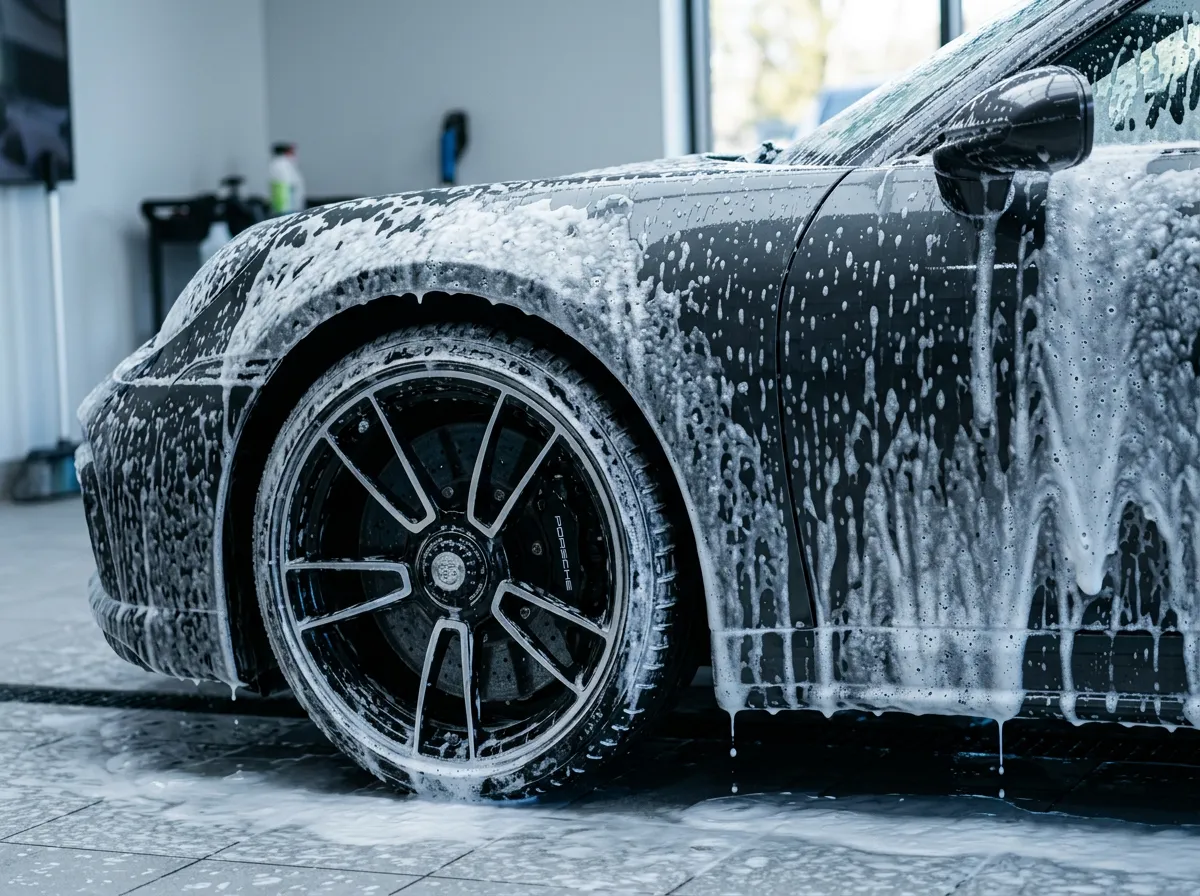
Before any microfiber wash mitt makes contact, the vehicle undergoes targeted pre-treatment. Dedicated pH-neutral citrus pre-sprays and high-density snow foam emulsify road film, bug spatter, and brake dust. Barrel brushes access deep inner wheel wells to break down bonded metallic brake fallout safely.
- High-viscosity foam encapsulation lifts abrasive grit before touching paint
- Chemical iron decontaminant neutralizes sintered metallic brake deposits
- Dedicated wheel woolies and boars-hair brushes for calipers and lug recesses
PHASE 02 : CONTACT WASH & AIR PURGE DRYING
ZERO-SWIRL CONTACT & TOUCHLESS DRYING
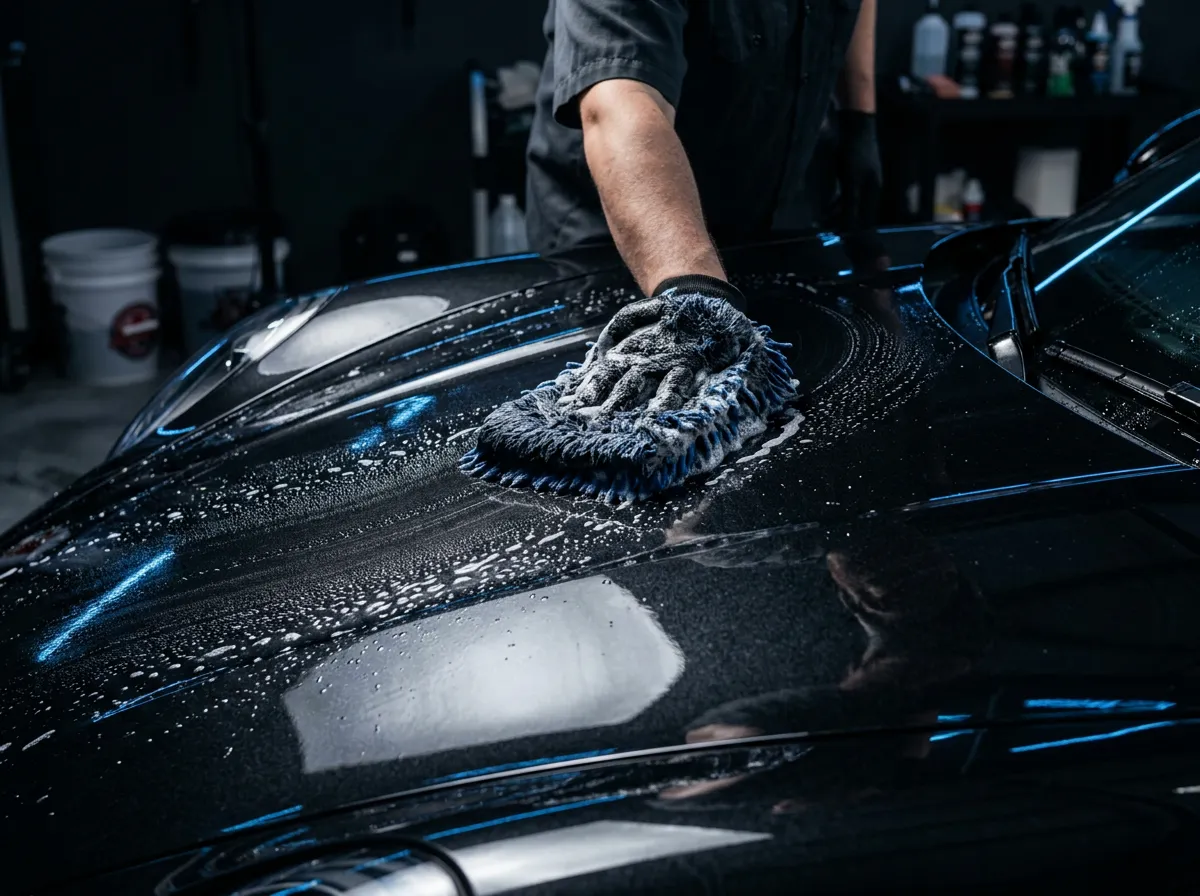
Contact washing uses a dual-bucket arrangement armed with submerged grit barriers and premium Korean microfiber mitts. Each panel is treated with straight-line strokes to avert micro-scratches. Drying is carried out using filtered warm-air blowers to expel trapped drops from window moldings, door jambs, and emblems without touching the paint.
- Two-bucket wash system prevents debris re-circulation onto clear coat
- Linear panel gliding technique preserves optical clarity without swirling
- Filtered warm-air turbine expels hidden droplets to stop water-spotting
The outcome is clinical clarity: zero wash-induced marring, zero water spots, and a medically clean substrate prepared for long-term hydrophobic sealants or ceramic shielding.
TAMPA BAY DRIVING REALITIES
WHY FLORIDA HIGHWAYS PUNISH FACTORY CLEAR COAT
Daily commuting between downtown Tampa, St. Petersburg, and Brandon exposes automotive paint to an aggressive microclimate. Constant expressway speeds on I-275 and the Selmon Expressway combine with humid coastal air, airborne silica, and seasonal insect chemistry to degrade unprotected automotive clear coats in months.
I-275 & SELMON EXPRESSWAY HIGHWAY BLAST
Sustained high-velocity travel across the Howard Frankland Bridge, Courtney Campbell Causeway, and the Selmon Expressway launches coarse road grit and micro-particulates straight into front fascias. Without ceramic-grade exterior defense, micro-pitting occurs rapidly.
ACIDIC LOVEBUG SPLATTER & 48-HOUR CLEAR ETCHING
Florida lovebugs carry an acidic body chemistry that turns corrosive when exposed to 90°F sunlight. Left unneutralized on your hood and bumper for over 48 hours, the enzymes chemically burn through automotive clear coat, creating permanent pitted scars.
COASTAL SALINITY & SUBTROPICAL UV DEGRADATION
Over 240 sunny days per year and humid salt-laden breezes from Old Tampa Bay accelerate clear coat oxidation and headlight yellowing. Without durable hydrophobic sealants, microscopic salt crystals dry into pores, promoting premature paint failure.
ENGINEERED FOR TAMPA CLIMATES: ALI'S TARGETED EXTERIOR PROTOCOL
Standard car washes drag recycled grit across your clear coat. Ali uses pH-neutral enzymatic foam baths, iron fallout neutralizers, and laboratory-grade ceramic coatings calibrated specifically for Florida humidity and road grime.
Calibrated for Tampa, St. Pete, & Brandon drivers
PRECISION EXTERIOR ARCHITECTURE
INTERACTIVE VEHICLE ZONE SPECIFICATION
Select an exterior section on the diagram or use the controls below to inspect targeted decontamination chemistry, mechanical care protocols, and substrate-safe sealant applications.
Mobile and climate-controlled studio appointments available across greater Tampa Bay.
SURFACE PREPARATION SPECIFICATIONS
CHOOSE YOUR EXTERIOR TREATMENT LEVEL
The fundamental difference between packages lies in the mechanical and chemical surface preparation. Pricing depends on your specific vehicle size and paint contamination levels.
MAINTENANCE & PRESERVATION
EXTERIOR CLEAN & PROTECT
Engineered for lightly soiled, regularly maintained vehicles requiring safe surface washing without abrasive contact. Removes topical road film and installs an instant hydrophobic barrier.
- High-lubricity pH-neutral foam pre-soak and gentle hand wash
- Wheel face and tire cleaning with non-acidic safe cleaners
- Streak-free glass cleaning and satin UV tire nourishment
- Synthetic spray sealant providing high-gloss surface slickness
- Surface Prep Scope: Non-mechanical wash (surface dirt only)
Note: Does not extract brake dust embedded into clear coat or remove industrial fallout.
DEEP RESTORATION & DECON
EXTERIOR DECONTAMINATION & PROTECTION
Intensive two-stage chemical and mechanical preparation for vehicles exposed to Florida sun, road film, and rail dust. Restores glass-smooth clear coat prior to high-durability protection.
- Complete pre-wash foam bath and multi-bucket grit-guard hand wash
- Chemical iron fallout dissolver applied to body panels and wheels
- Mechanical fine-grade clay bar treatment extracting embedded grit
- Tar, bug splatter, and tree sap spot decontamination process
- Surface Prep Scope: Complete porous pore extraction for glass-smooth feel
Essential step: Strongly recommended every 6-12 months or as the prerequisite foundation for ceramic coatings.
IN&OUT PACKAGE PRICING
COMPLETE IN&OUT PACKAGES
Transparent flat-rate pricing combining thorough exterior wash protection with comprehensive interior detailing. Choose your desired level of care below.
ESSENTIAL REJUVENATION
CLASSIC IN&OUT
$199
Base rate for sedans and two-row vehicles. Includes complete interior & exterior.
- Full foam bath and gentle two-bucket contact wash
- Deep cleaning of wheel faces, barrels, and tire dress
- Interior cabin compressed air blowout and thorough vacuum
- Dashboard, console, and door jamb wipe-down sanitization
- Interior and exterior streak-free crystal glass clarity
- Protective spray gloss sealant for 30-day paint protection
MOST POPULAR - DEEP RESTORATION
GOLD IN&OUT
$299
Base rate for sedans and two-row vehicles. Includes complete interior & exterior.
- Everything included in the Classic In&Out package
- Chemical iron decontamination and clay bar paint prep
- Deep hot-water carpet, floor mat, and seat shampoo extraction
- Intensive leather steam cleaning and UV conditioning
- Door jamb detailing and plastic trim revitalization
- 6-month hydrophobic ceramic sealant applied to all paint
CRITICAL SERVICE SCOPE & THREE-ROW SURCHARGE NOTICE
Important: The Classic ($199) and Gold ($299) packages listed above are complete In&Out treatments that include intensive interior detailing alongside exterior paint care. These are NOT exterior-only prices. Standard pricing applies to sedans, coupes, and 2-row vehicles. Due to expanded cabin volume and seating capacity, a mandatory $50 surcharge applies to all 3-row SUVs, minivans, and extended passenger vehicles.
METHODOLOGY & RESTORATION THRESHOLDS
CHEMICAL VS. MECHANICAL DECONTAMINATION
A standard contact wash removes loose grime, but bonded micro-contaminants require progressive intervention. Understand the exact operational function, chemical chemistry, and technical boundaries of every stage.
STAGE 01 : CHEMICAL REACTION
IRON DECONTAMINATION
A pH-balanced chemical spray reacts with sintered metallic brake dust and rail fallout embedded into the clear coat pores. It chelates iron particles, turning purple as it dissolves them without mechanical friction.
- Dissolves sub-surface ferrous shrapnel completely
- Eliminates risk of dragging sharp iron during clay stage
- Process limit: Will not dissolve road tar, tree sap, or paint marring
STAGE 02 : MECHANICAL SHEARING
CLAY BAR TREATMENT
A synthetic resin clay medium slides over dedicated high-lubricity surfactant mist to physically grab and shear off above-surface bonded organic sap, stubborn road tar, and overspray that chemistry cannot penetrate.
- Restores completely glass-smooth tactile paint feel
- Pulls tree pitch, insect residue, and industrial fallout
- Process limit: Cannot remove swirl marks, scratches, or etchings
STAGE 03 : SUB-SURFACE LEVELING
PAINT CORRECTION
Dual-action machine polishers with graded micro-abrasives level the top microscopic layer of clear coat. This permanently cuts out wash swirls, spider webbing, bird dropping etchings, and oxidization defects.
- Permanently removes 85-95% of clear coat swirl marks
- Restores authentic optical mirror gloss and true color depth
- Process limit: Cannot fix deep scratches extending through clear coat to primer
NOT SURE WHICH CORRECTION LEVEL YOUR CLEAR COAT REQUIRES?
We evaluate paint depth, clear coat hardness, and contaminant saturation with digital thickness gauges before touching your vehicle.
PROFESSIONAL DETAILING STANDARDS
CHEMICAL BENCHMARKS & FORMULATIONS
Surface preservation relies on exacting chemical engineering. We benchmark our exterior workflows against the industry's most rigorous German, Italian, and specialty laboratory formulations: pH-balanced decontamination, silica matrixes, and precision micro-abrasives.
Note: Brand references serve as technical examples of industry chemical formulations and performance standards deployed in high-tier detailing practices.
STANDARDIZED PROTOCOL // ZERO COMPROMISES
THE 12-STEP EXTERIOR MASTER PROCESS
Every vehicle passing through our studio undergoes this exhaustive, documented procedure. From microscopic contaminant stripping to climate-controlled curing, here is how we protect your investment against Florida heat, salt air, and relentless UV radiation.
STEP 01 // PHASE ONE: EVALUATION
CLEAR COAT THICKNESS & SURFACE AUDIT
We log digital ultrasonic gauge readings across all panels to map clear coat depth. Any prior repairs, thin edges, rock chips, or acid etchings are cataloged before chemical or abrasive work begins.
STEP 02 // PHASE ONE: WHEELS & RUNNING GEAR
WHEEL BARREL, CALIPER & ARCH EXTRACTION
Treated first to stop brake dust cross-contamination. Inner barrels, brake calipers, and wheel wells receive dedicated pH-balanced cleaners, soft wool boars-hair agitations, and high-pressure hot water flushes.
STEP 03 // PHASE TWO: PRE-TREATMENT
CITRUS HIGH-LUBRICITY FOAM PRE-WASH
A dense blanket of biodegradable citrus foam encapsulates abrasive surface grime, lovebug enzymes, and coastal grit. This dwell stage softens bonded matter so it rinses free before any mitt touches the paint.
STEP 04 // PHASE TWO: CONTACT DECON
TWO-BUCKET GRIT-GUARD CONTACT WASH
Utilizing Korean ultra-plush microfiber mitts with individual clean and rinse reservoirs fitted with dual grit guards. Straight-line strokes only - never circular motion - preventing surface swirl marks.
STEP 05 // PHASE THREE: DEEP PURIFICATION
CHEMICAL IRON FALLOUT & TAR DISSOLUTION
Specialized pH-neutral chemical reactive sprays dissolve embedded ferrous brake shrapnel, turning purple on contact. Solvent-based tar removers lift stubborn asphalt splatters from lower rocker sills safely.
STEP 06 // PHASE THREE: MECHANICAL LEVELING
FINE-GRADE MECHANICAL CLAY BAR SHAVING
Synthetic ultra-fine clay media lubricated with slick polymeric spray glides over clear coat and glass. This extracts microscopic industrial fallout, paint overspray, and tree sap, restoring factory glass smoothness.
STEP 07 // PHASE FOUR: DRYING & MASKING
TOUCHLESS FILTERED WARM-AIR CREVICE PURGE
Pressurized, heated filtered air evacuates trapped mineral water from mirror housings, door jamb seals, grilles, and badge crevices. Zero towel contact during this phase eliminates risk of micro-marring dry surfaces.
STEP 08 // PHASE FOUR: OPTICAL PREP
RUBBER MASKING & ISOPROPYL PANEL STRIP
Delicate matte vinyl, camera sensors, and rubber gaskets are taped with low-tack automotive vinyl film. Every panel is then wiped with an alcohol solution to remove leftover polishing oils and reveal pure clear coat.
STEP 09 // PHASE FIVE: ENHANCEMENT
PRECISION DUAL-ACTION PAINT POLISHING
Calibrated dual-action polishers with matched micro-abrasive compounds jewel the clear coat. This pass eliminates wash haze, light towel marring, and chemical staining while maximizing specular reflection.
STEP 10 // PHASE FIVE: PROTECTION SHIELD
CERAMIC-INFUSED HYDROPHOBIC BONDING
We cross-link an SiO2 ceramic sealant into clear coat pores under controlled shop conditions. This locks in hyper-gloss, creates a high contact-angle water bead barrier, and shields against intense Florida sunshine.
STEP 11 // PHASE SIX: EXTERIOR ACCENTS
GLASS HYPER-SLICK & SATIN TRIM RESTORATION
Windshield and side glass receive a rain-repellent hydrophobic coating for wet-weather driving safety. Unpainted exterior plastics and tire sidewalls are nourished with non-greasy, zero-sling UV conditioners.
STEP 12 // PHASE SIX: FINAL HANDOFF
MULTI-SPECTRUM LED INSPECTION & HANDOFF
Before handoff, we audit every body panel under calibrated high-CRI inspection lights across warm, daylight, and cool spectrums. We walk you through every finished section with custom post-care documentation.
Appointments available Monday through Saturday. Clear coat thickness reports included with all stages.
ILLUSTRATIVE COMPARISON
WHEEL-FACE & TRIM RESTORATION
Drag the interactive divider to inspect how dedicated chemical de-ironization and UV-stabilizing dressings strip baked brake dust and restore faded trim to a factory satin finish. Individual outcomes vary with prior sun exposure and substrate wear.

FERROUS CHEMICAL REMOVAL
Brake dust fuses iron sintered particles into rim clear coats. We dissolve these contaminants with pH-neutral active chelators rather than abrasive acid washes.
NON-SLING SATIN HYDRATION
Tire sidings receive penetrating silicone-free emulsions that cure completely dry to the touch, avoiding unsightly fender spray while resisting road grime pickup.
UV OXIDATION BARRIER
Chalky cowl covers and unpainted wheel arch plastics are degreased and sealed with UV absorbers to forestall sun-bleaching without temporary greasy finishes.
Fast online assessment • Transparent upfront estimates • Dedicated care in Tampa, FL
HONEST STANDARDS & CLARITY
WHAT DETAILING CANNOT CHANGE
True professional detailing levels swirl marks, decontaminates pores, and locks in high-gloss defense. However, detailing does not replace body shop spray booths. We diagnose your paint honestly before touching a single panel.
CLEAR COAT FAILURE
When UV exposure burns through the clear coat causing milky flaking, peeling edges, or chalky basecoat exposure, the protective resin matrix is physically missing.
Honest Reality: Polishing cannot add clear coat back. Running a compound polisher over peeling clear coat will widen the damage. This requires professional panel repainting.
DEEP PRIMER GOUGES
If a scratch catches your fingernail firmly or shows a gray, white, or bare metal substrate, the scratch has cut entirely through the clear coat and basecoat.
Honest Reality: Paint correction safely rounds scratch edges to decrease visibility by 60% to 80%, but complete erasure without paint fill is physically impossible.
BAKED CHEMICAL ETCHING
In Tampa's intense heat, acidic bird droppings or reclaimed irrigation water can eat deep into the clear coat in under 48 hours, leaving microscopic sub-surface craters.
Honest Reality: Multi-stage machine compounding removes surface discoloration and smooths edges, but chasing 100% depth risks clear coat burn-through.
NOT SURE ABOUT YOUR VEHICLE PAINT CONDITION?
Send us close-up photos or visit for a direct paint depth gauge assessment. We will tell you exactly what can be restored and what cannot.
PRESERVATION STANDARDS
EXTERIOR CARE: WHAT TO DO VS. WHAT TO AVOID
Clear coat preservation requires systematic discipline. Protecting your vehicle against Florida's intense UV index, road film, and abrasive wash methods separates immaculate gloss from micro-marring.
RECOMMENDED MAINTENANCE (DO)
Proven habits that extend surface depth, preserve hydrophobic coatings, and keep clear coat scratch-free.
- Use the two-bucket method with grit guards to isolate debris away from your wash mitt
- Wash exclusively with pH-neutral automotive shampoo engineered for protective coatings
- Dry gently using 1000+ GSM edgeless microfiber drying towels or filtered forced air
- Wash in shaded conditions or during cooler morning and evening hours to prevent water spotting
- Pre-rinse with high-pressure touchless foam before contacting panels with wash media
CRITICAL RISK FACTORS (DON'T)
Common mistakes that grind abrasive road grime into clear coat, introducing deep swirl marks and etching.
- Never run your vehicle through automated nylon tunnel washes that whip grit across panels
- Never dry-wipe dusty bodywork with quick detailer, gas station towels, or dry cloths
- Avoid household dish soaps which strip protective sealants and dry out rubber moldings
- Never wash or allow water to bake onto dark panels directly under the scorching Florida sun
- Avoid circular wiping motions which concentrate micro-scratches into visible concentric swirls
POST-SERVICE CARE PROTOCOL
HOW TO MAINTAIN THAT FRESH SHOWROOM SHINE
A meticulous exterior detail strips surface oxidation and locks in protective gloss. To prevent premature wear from harsh Tampa UV radiation, afternoon rainstorms, and roadway grit, follow these three essential post-care standards.
WASH FREQUENCY
Wash your car every 10 to 14 days to stop environmental fallout from etching clear coats. Never run through spinning-brush automated car washes, which will abrade the wax barrier and leave noticeable micro-scratches.
- Two-bucket wash method with grit guards
- pH-neutral car shampoo only
- Dedicated plush microfiber wash mitt
TOUCHLESS PRE-RINSE
Never wipe dry body panels. Loosen abrasive sand, brake residue, and bug splatter using a pressure washer pre-rinse or snow foam application before touching the vehicle. Lubrication is your clear coat’s best defense.
- Blast heavy traffic grime before contact
- Soak with high-lubricity snow foam
- Rinse mitt constantly in rinse bucket
3-MONTH WAX LIFESPAN
Standard carnauba or synthetic paste waxes reliably last approximately 90 days in Central Florida. When water stops forming tight round beads and begins sheeting flatly, your protective layer has expired and requires renewal.
- Expect 8 to 12 weeks of peak defense
- Watch for degraded water-beading tension
- Book seasonal refresh before total breakdown
PREFER WE HANDLE YOUR ROUTINE MAINTENANCE WASHES?
Book a scheduled maintenance wash with Ali’s Car Detailing to ensure zero wash-induced marring and regular sealant top-ups.
TRANSPARENT ESTIMATING
WHAT SHAPES YOUR CUSTOM QUOTE
Precision exterior detailing is calculated around your vehicle's physical reality, not arbitrary menu tiers. Here are the core technical variables evaluated during every quote.
VEHICLE SIZE & SHAPE
Square footage directly dictates chemical volume and polishing labor. A low-slung roadster requires vastly different stage hours than an extended wheelbase pickup or 3-row family SUV.
FACTOR: SQUARE FOOTAGE & ROOF PROFILE
PAINT & CLEAR COAT DEFECTS
Depth of clear coat etching, car-wash swirl density, and water spot calcification determine whether a single-stage polish or multi-step compound and refine pass is required.
FACTOR: DEFECT DEPTH & SWIRL DENSITY
CONTAMINATION BUILDUP
Embedded rail dust, brake fallout, marine salt crust, and tree sap require multi-cycle chemical dissolution and clay treatment before any corrective machine pads touch the paint.
FACTOR: FALLOUT, IRON & SAP DEPOSITS
EXISTING COATINGS & TRIM
Stripping degraded dealership waxes, compounding oxidized rubber, or prepping virgin clear coat for long-term ceramic bonding each requires tailored chemical stages and masking prep.
FACTOR: STRIP PROCESS & SURFACE PREP
No surprises or hidden fees. We inspect your vehicle condition upfront before starting work.
GREATER TAMPA BAY COVERAGE
REGIONAL SERVICE COVERAGE ACROSS 3 COUNTIES
Self-contained mobile detailing units equipped with spot-free deionized water and independent power rigs, servicing residential driveways, corporate complexes, and private estates daily.
HILLSBOROUGH COUNTY
Primary metro deployment sector with priority booking and multiple mobile rigs circulating daily.
Downtown Tampa | South Tampa | Brandon | Westchase | Carrollwood | Riverview | Davis Islands | Hyde Park | Temple Terrace | Lutz
- Zero travel fee within core county limits
- Rapid 24-48h scheduling windows
- Fleet-ready on-site water and electrical generators
PASCO COUNTY
Northern corridor service covering luxury master-planned communities and suburban equestrian acreage.
Wesley Chapel | Land O' Lakes | Trinity | Odessa | Wiregrass | New Port Richey | Zephyrhills | San Antonio
- Direct driveway appointments for gated communities
- Shaded canopy set up for sun protection during treatments
- HOA-compliant low-noise generator equipment
PINELLAS COUNTY
Coastal peninsula coverage specialized in maritime salt-spray removal and marine-grade UV paint sealants.
St. Petersburg | Clearwater | Dunedin | Palm Harbor | Safety Harbor | Largo | Belleair | St. Pete Beach
- Coastal salt and airborne fallout decontamination protocols
- Condo garage and covered carport compatibility
- Weekly and bi-weekly recurring maintenance slots
TECHNICAL CLARITY & PROTOCOLS
FREQUENTLY ASKED QUESTIONS
Detailed answers covering mobile service logistics, mechanical decontamination, wheel arch restoration, and paint chemistry.
What utility connections or property access do I need to provide for mobile detailing?
Our specialized mobile rigs arrive fully self-contained with onboard high-capacity filtered water tanks and commercial ultra-quiet Honda generators. We require zero external water spigots or electrical outlets from your property, making residential driveways and corporate office parking lots completely seamless.
Can exterior detailing procedures be executed in direct sunlight or an uncovered driveway?
While covered shade or a garage is always welcome, our chemistry utilizes temperature-stable, pH-neutral foams and specialized ceramic polymers specifically engineered not to flash or spot under Florida sun. For multi-stage polishing or extreme midday heat, our mobile units deploy commercial UV-rated canopies.
How much clearance and physical space is needed around the vehicle?
We request a minimum of 4 to 5 feet of unobstructed clearance on all four sides of your vehicle. This perimeter allows our technicians to safely maneuver high-pressure wash lances, rolling utility carts, and precision lighting stands without risking incidental contact with adjacent structures.
What is the policy when sudden afternoon rain showers or thunderstorms develop in Tampa?
We monitor Doppler radar throughout every appointment. If passing showers occur and no enclosed garage is available, our mobile canopies protect the vehicle during wet stages. In cases of severe localized lightning or sustained downpours, we pause and prioritize immediate reschedule slots with zero penalty fees.
Are your wash processes compliant with local environmental runoff guidelines and water restrictions?
Yes, we adhere strictly to municipal Hillsborough and Pinellas environmental compliance. We utilize biodegradable, phosphate-free cleaning agents and capture wash runoff with containment mats and high-efficiency reclaim filtration whenever required by commercial property mandates.
What is a clay bar treatment and why is it essential prior to sealing the paint?
A clay bar is a specialized poly-clay compound that physically pulls embedded surface contaminants out of the clear coat pores: including rail dust, industrial fallout, brake particles, and tree sap. Applying wax or ceramic over un-clayed paint traps abrasive grit, compromises bonding, and limits gloss depth.
Does a clay bar remove swirl marks, etchings, or physical paint scratches?
No. Clay bars are purely decontamination tools engineered to remove above-surface bonded contaminants, not below-surface defects. Eliminating paint swirls, bird-dropping etching, or scratches requires machine paint correction with abrasive compounds and dual-action polishing pads.
How frequently should an exterior clay bar decontamination be conducted on a Florida vehicle?
In our coastal, high-UV climate with intense airborne sea mist and highway traffic, we recommend clay decontamination every 6 to 12 months. Vehicles stored outdoors near industrial corridors or parked under pine trees may benefit from semi-annual decontamination.
What is the distinction between chemical iron decontamination and mechanical clay bar treatment?
Chemical decontamination utilizes pH-neutral iron removers that chemically react with and dissolve sintered ferrous brake particles, turning purple as they liquefy. Mechanical claying physically shears off remaining organic sap, tar, and non-ferrous grit that chemicals cannot fully dissolve.
Is there a risk that clay barring will leave micro-marring on soft clear coats?
When executed improperly with inadequate lubrication or coarse clay, fine marring can occur. That is why we utilize high-lubricity dedicated clay sprays and ultra-fine synthetic clay media, consistently folding the medium to ensure the clear coat remains flawless and mar-free.
What steps are taken to thoroughly decontaminate and clean inner wheel wells?
Wheel wells accumulate road tar, rubber sling, and abrasive road grime. We apply dedicated citrus degreasers and foaming iron dissolvers, agitated using ergonomic long-reach flag-tipped brushes and low-profile barrel tools, followed by 40-degree pressurized rinsing up to 1,800 PSI.
How do you clean textured fabric or felt liners differently from standard molded plastic?
Felt fender liners trap road sediment and dried grass within their fibrous weave. We pre-vacuum loose debris when dry, apply non-foaming upholstery surfactants, and utilize specialized stiff-bristle extraction brushes alongside rinse extraction rather than harsh chemical degreasers that degrade fabric backing.
Are suspension components, control arms, and brake calipers detailed during wheel arch cleaning?
Yes, our wheel and arch decontamination reaches visible suspension linkages, coil springs, and painted brake calipers. We utilize dedicated non-acid wheel cleaners and precision horsehair brushes to lift corrosive brake buildup without attacking anodized caliper seals.
What protective barrier is applied to fender liners to prevent grey fading and chalking?
After complete drying, plastic fender liners receive an application of hydrophobic, water-based fluoropolymer dressing that restores deep satin black appearance without leaving an oily residue that attracts road dust. It actively resists salt mist and road grime adhesion.
How do you safely remove stubborn baked-on metallic brake dust from inner wheel barrels?
We utilize pH-neutral color-changing iron catalysts that chemically dissolve sintered brake particles at the molecular level. This eliminates the need for harsh hydrofluoric acid washes, ensuring factory-cleared, powder-coated, or polished alloy finishes are preserved without chemical pitting.
What is the core chemical difference between traditional carnauba wax and ceramic-infused products?
Carnauba wax is a natural organic palm wax that sits on top of the clear coat, offering warm depth but low melting resilience. Ceramic-infused products contain synthetic silicon dioxide (SiO2) polymers that chemically bond into microscopic clear coat pores, forming a much harder, durable matrix.
How does intense Florida heat and UV radiation affect carnauba wax compared to ceramic protection?
Natural carnauba wax has a melting threshold near 180 degrees Fahrenheit; dark vehicle panels exposed to Tampa summer sun routinely reach 170 to 190 degrees, evaporating conventional wax within 3 to 4 weeks. Ceramic SiO2 products withstand temperatures in excess of 400 degrees, maintaining UV rejection year-round.
Can ceramic-infused spray sealants be layered directly on top of a conventional paste wax?
No. Ceramic sealants require a squeaky-clean, oil-free paint surface to crosslink with the clear coat. Layering ceramic over wax causes the ceramic to wash away prematurely once the underlying wax breaks down. The proper protocol is applying ceramic directly to bare, prepped paint.
What difference in water behavior and self-cleaning ability will I notice between wax and ceramic?
While fresh wax creates circular beads, ceramic-infused coatings generate extreme contact angles exceeding 105 degrees. This creates rapid water sheeting and the 'lotus effect', allowing highway airflow and rain to actively carry away surface dust and mineral spots before they bake into the paint.
What is the expected real-world durability of a ceramic-infused sealant versus paste wax in Florida?
Under intense Gulf Coast UV and frequent tropical rainfall, premium paste wax typically degrades within 30 to 45 days. In contrast, professional SiO2 ceramic-infused sealants routinely deliver 6 to 9 months of active hydrophobicity, chemical resistance, and rich reflective clarity.
TAMPA BAY PRECISION DETAILING QUOTE
REQUEST YOUR TAMPA EXTERIOR DETAILING QUOTE
Provide your vehicle profile below to calculate accurate exterior decontamination, single or multi-stage paint refinement, and certified ceramic protection specs with guaranteed transparent pricing.
PREFER AN IMMEDIATE ESTIMATE?
Speak directly with Ali or an exterior detailing technician to evaluate paint defects, discuss salt air decontamination, or confirm same-day Tampa mobile availability.
- Direct technician evaluation on severe water spots
- Clear time frames and exact service arrival windows
- Custom corporate fleet and multi-car arrangements
Service Hours: Monday - Saturday: 7:30 AM - 6:30 PM
ALI’S CAR DETAILING
Professional exterior automotive detailing, precision chemical decontamination, and clear coat preservation tailored for Tampa Bay drivers.
TAMPA LOCATION & CONTACT
Address:
5555 W Linebaugh Ave
Tampa, FL 33614
Phone: (813) 945-4054
Email: [email protected]
OPERATING SCHEDULE
Mon - Fri: 8:00 AM - 6:00 PM
Saturday: 8:00 AM - 4:00 PM
Sunday: Closed for Restock
Tampa Bay Licensed & Insured
© 2026 Ali’s Car Detailing. All rights reserved. Exterior automotive care serving Tampa, FL.